

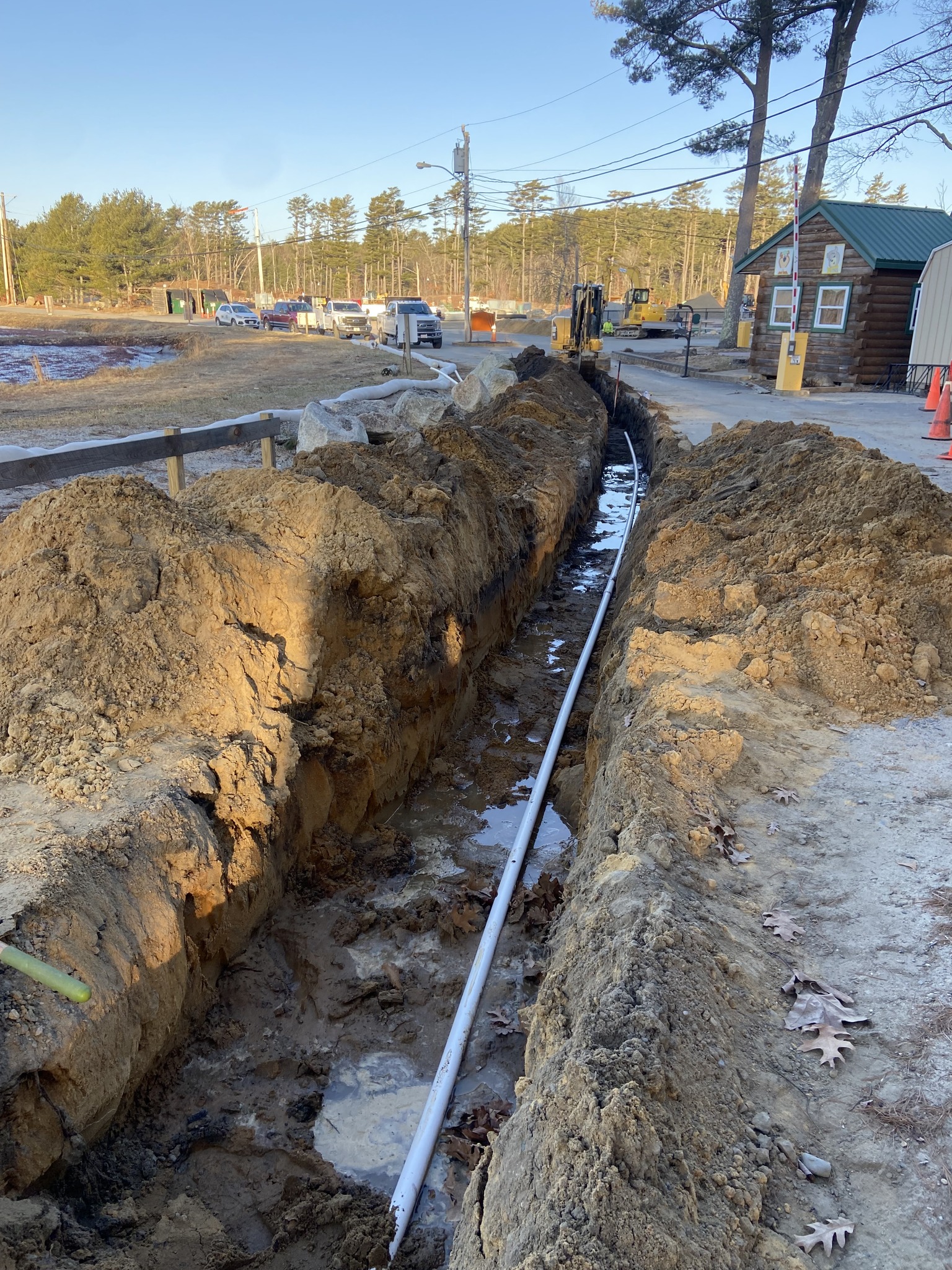
If your yard is still soggy two days after a rainstorm, the problem isn’t the rain — it’s where the water has nowhere to go. A French drain is one of the most effective ways to fix poor yard drainage: a gravel-filled trench with a perforated pipe that collects groundwater and surface runoff and redirects it away from your property. Most Plymouth County homeowners don’t think about drainage until a problem is already costing them money in soggy basements, eroding slopes, or flooded patios.
We’ve walked dozens of South Shore properties where the issue wasn’t dramatic — no flooded basement, no obvious erosion — just a yard that stayed wet for days after every storm and slowly started killing the lawn. That persistent saturation is exactly what a well-designed drainage system is built to solve.
What a French Drain Is (And What It Isn’t)
A French drain is a subsurface drainage channel, not a surface ditch. It consists of a sloped trench, a layer of gravel or crushed stone, and a perforated pipe that moves water along the path of least resistance — away from your home, lawn, or foundation.
The “French” in the name has nothing to do with France. It comes from Henry French, a Massachusetts farmer and judge who popularized the technique in his 1859 book on farm drainage. The system has barely changed since then because it works.
Did You Know? French drains are not the same as curtain drains or surface swales, though all three are sometimes used together on the same property. A French drain works underground; a swale moves surface water at grade. Knowing the difference matters when you’re getting quotes — not all drainage solutions are interchangeable.
Where Water Problems Actually Start
Most yard drainage problems in New England come from one of three sources: soil that doesn’t absorb water fast enough (common with the clay-heavy soils around Plymouth County), properties graded so water flows toward the house instead of away, and impervious surfaces like driveways and patios that concentrate runoff onto unprepared lawn areas.
July and August make these problems worse. Summer thunderstorms dump large amounts of rain quickly — faster than most residential soil can absorb — and the ground is often already at partial saturation from earlier storms in the season.
Signs Your Property Has a Drainage Problem
Not every wet yard needs a French drain, but certain patterns point clearly to a drainage issue that won’t fix itself.
Standing water that takes more than 24 to 48 hours to drain after a storm is the most common sign. Another is a basement or crawl space that smells musty after rain, even without visible water intrusion — that moisture is working through the foundation wall from saturated soil. Erosion channels forming in the same spots after every storm mean water is consistently overloading those areas.
Pro Tip: Take a walk around your property during or right after a heavy rain, not the next day. Watching where water collects and where it flows in real time tells you far more than inspecting a dry yard. We do this on every drainage assessment we run — the pattern is almost always obvious within the first five minutes of observation.
Soggy patches that stay wet even during dry spells, especially near the foundation or along a slope, often point to a high water table or subsurface flow that a French drain can intercept before it reaches the house.
How a French Drain Works
The mechanics are simple but the installation details matter. A trench is dug at a slope — typically a minimum of 1% grade, meaning at least 1 inch of drop per 10 feet of run. The trench is lined with landscape fabric to prevent soil from clogging the gravel, then filled with crushed stone. A perforated pipe sits in the gravel and carries collected water to a daylight outlet, dry well, or storm drain.
Water enters the system two ways: through the perforations in the pipe as groundwater rises, and by flowing into the top of the trench as surface runoff. The gravel acts as both a filter and a reservoir, slowing the water down and giving the pipe time to carry it away.
| Component | Purpose |
| Sloped trench | Creates gravity-fed water movement |
| Landscape fabric | Prevents soil from filling the gravel over time |
| Crushed stone | Filters water and provides storage capacity |
| Perforated pipe | Channels collected water to an outlet |
| Outlet point | Releases water away from the problem area |
Proper slope and outlet placement are where most DIY French drains fail. A drain that doesn’t have enough fall, or that outlets onto a neighbor’s property or into an area that just re-saturates, creates a new problem instead of solving the original one. Professional drainage solutions involve a site assessment before any digging starts.
When a French Drain Is the Right Fix — and When It Isn’t
A French drain works well for: groundwater seeping into a basement from the sides, water pooling in a low area of the yard, slope drainage where water runs toward the foundation, and wet areas that stay saturated after rain.
It’s not the right fix for: rooftop runoff that’s not being managed by gutters and downspouts (that’s a grading and downspout extension problem first), surface flooding caused by a driveway or patio that’s directing water at the house (that’s a grading and site preparation issue), or high water table conditions that require a sump pump system instead.
Did You Know? In Massachusetts, drainage work that connects to municipal storm systems or affects wetland buffer zones may require a permit. Properties within 100 feet of a wetland — common across Plymouth County and the South Shore — need a filing with the local Conservation Commission before any drainage work begins.
What to Expect From a Drainage Assessment
When we assess a property for drainage, we’re looking at three things before recommending anything: where the water is coming from, where it’s going, and what’s in between. Grade, soil type, proximity to structures, and the location of existing utilities all factor into the design.
A straightforward French drain installation on a residential property in southeastern Massachusetts typically involves a full day of excavation, with the trench depth and length depending on how much water the system needs to handle and how far the outlet needs to run. Properties that also need land clearing or regrading before drainage work can be installed add time to the project.
Most homeowners are surprised that the design conversation takes longer than they expect — because a drain installed in the wrong location just moves a water problem rather than solving it.
Frequently Asked Questions
How deep does a French drain need to be?
Most residential French drains are installed between 18 and 24 inches deep, though foundation drains may go deeper depending on the footing depth. The slope of the trench matters more than the depth — a minimum 1% grade is needed to keep water moving toward the outlet.
How long does a French drain last?
A properly installed French drain with landscape fabric lining typically lasts 30 to 40 years before the gravel or fabric needs attention. Systems installed without fabric tend to clog with fine soil particles much sooner, often within 10 years.
Does a French drain require a permit in Massachusetts?
It depends on the location and outlet point. Drainage work near wetlands, waterways, or municipal storm systems usually requires a permit or Conservation Commission filing. A contractor familiar with local regulations can advise on what applies to your specific property.
Can I install a French drain myself?
The trench digging and pipe laying are physically straightforward, but proper grade, outlet selection, and fabric installation require some experience to get right. Poorly sloped or poorly terminated drains often make water problems worse, not better.
What is the difference between a French drain and a dry well?
A French drain moves water laterally along a trench to a discharge point. A dry well collects water in a single subsurface pit and lets it percolate slowly into the surrounding soil. The two are often used together — the French drain collects and moves water to the dry well, which handles final dispersal.
Ready to stop watching your yard flood every July? Contact NE Services to schedule a drainage assessment and find out which solution fits your property before the next storm hits.